FeaturedDigital Download
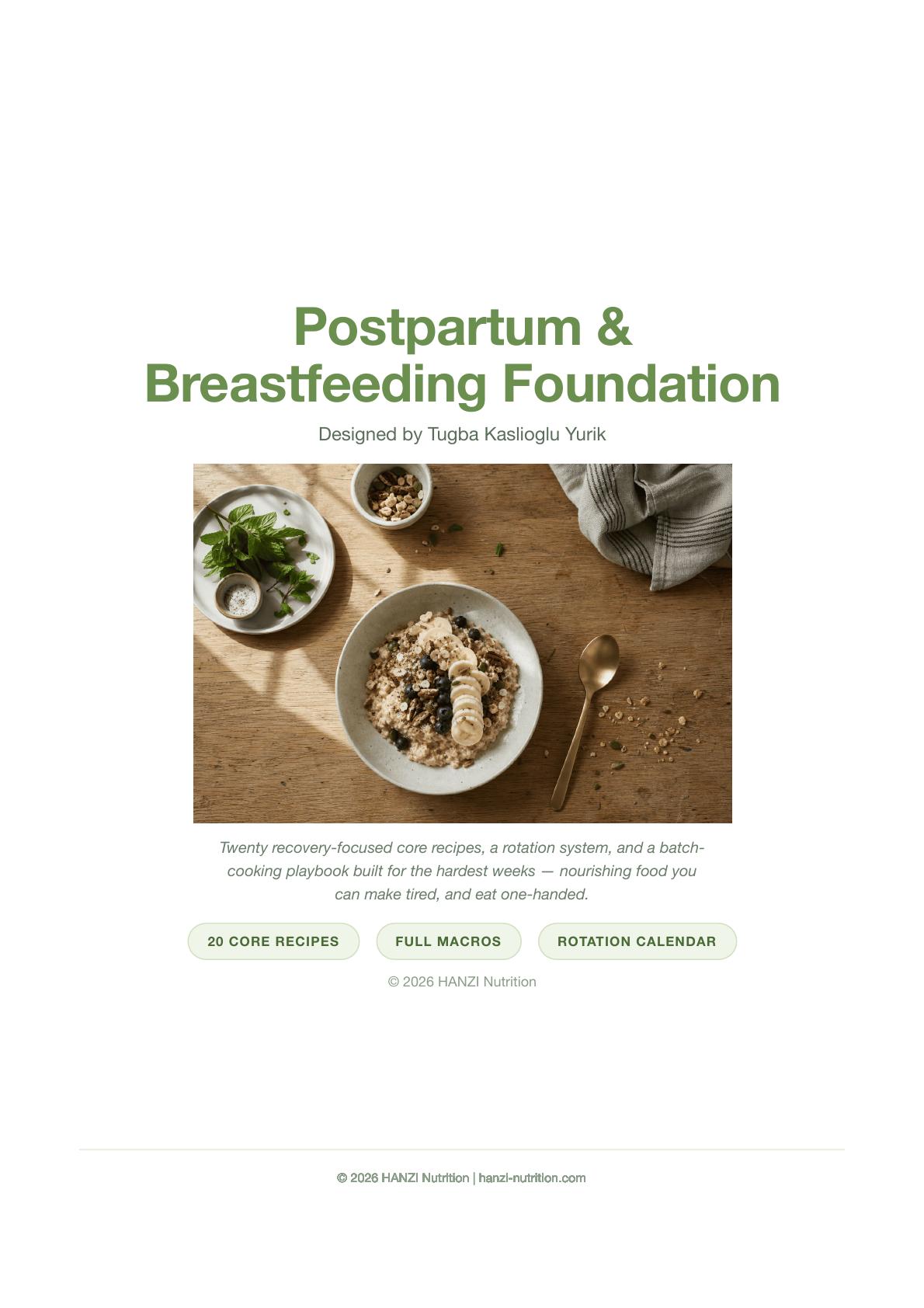
Postpartum & Breastfeeding Foundation
€7.99
A 4-week rotation plan built around 20 recovery-focused core recipes — six breakfasts, seven lunches, seven dinners — minimal-prep, freezer-friendly, and manageable on little sleep. The plan emphasise...
1
Secure Payment
Instant Download
Satisfaction Guaranteed
What You'll Get
- Downloadable PDF (37 pages)
- 20 unique recipes (20 mains + 0 snacks)
- 0-day sample rotation
- Weekly shopping list
- 5 cited references
From Tugba
If you are reading this in the early weeks after a birth, you are likely doing it one-handed, half-asleep, or both — and being told, from every direction, to “look after yourself” without much practical sense of how. My aim with this plan is narrow and, I hope, kind: a set of everyday meals built for recovery and, if you are doing it, breastfeeding — iron to replenish what birth took, enough calories and fluid, whole grains, real protein — assembled so you can actually make them on no sleep, or have them already waiting in the freezer.
Much of what is here is about removing decisions. The recipes are minimal-prep and freezer-friendly on purpose; many can be eaten with one hand while you hold a baby. The Batch-Cooking Playbook — the heart of this plan — is there so that the cooking happens before you are too tired to think, and so you have a clear answer when someone asks what they can bring.
What this plan is: a sustainable rotation of nourishing, recovery-focused food. What it is not: postnatal medical care. It does not replace your midwife, your health visitor, your GP, or your six-week check, and it is not a treatment for any postnatal condition. Recovery from birth is not linear and it is not quick — please be as patient with your body as you would be with a friend's. There is no rush here, and no version of this where eating well means eating less. Eat enough. Drink more water than feels necessary. The recipes will keep.
Much of what is here is about removing decisions. The recipes are minimal-prep and freezer-friendly on purpose; many can be eaten with one hand while you hold a baby. The Batch-Cooking Playbook — the heart of this plan — is there so that the cooking happens before you are too tired to think, and so you have a clear answer when someone asks what they can bring.
What this plan is: a sustainable rotation of nourishing, recovery-focused food. What it is not: postnatal medical care. It does not replace your midwife, your health visitor, your GP, or your six-week check, and it is not a treatment for any postnatal condition. Recovery from birth is not linear and it is not quick — please be as patient with your body as you would be with a friend's. There is no rush here, and no version of this where eating well means eating less. Eat enough. Drink more water than feels necessary. The recipes will keep.
— Tugba
Plan at a Glance
Daily macronutrient split
Fat — 30%
Protein — 25%
Carbs — 45%
20 Core RecipesFull MacrosRotation Calendar
Clinical Foundations
The evidence behind this plan, and what the data does and doesn't show
The weeks after a birth place real, specific demands on the body, and they are different from pregnancy's. Birth involves blood loss, so iron stores are often depleted; iron-rich foods — red meat, lentils, beans, dark leafy greens — support replenishment, and iron from food is absorbed better in the presence of vitamin C. Healing tissue — including after a caesarean or perineal repair — draws on adequate protein and overall energy intake. If you are breastfeeding, milk production raises both energy and fluid requirements; whole grains, regular meals and steady hydration help meet that demand, and a varied diet is generally recommended alongside any vitamin D or other supplementation your clinician advises. National guidance commonly puts the additional energy cost of established breastfeeding at roughly 330 to 400 kcal a day. Sleep deprivation also makes regular, easy-to-eat meals harder to manage — which is a practical problem this plan is built to solve, not a willpower one.
⚠ Who this plan isn’t designed for
This plan is general nutrition guidance for postpartum recovery and breastfeeding — it is not a substitute for postnatal medical care, and it is not a treatment for any postnatal condition. Please use it only alongside your care team, and follow their advice over this plan, in the following situations. If you have had a postpartum haemorrhage or other birth complication, your recovery — including any iron supplementation — should be directed by your clinician; this plan supports that, it does not replace it. If you are recovering from a caesarean or a perineal repair, follow the specific guidance you have been given on activity, lifting and wound care. If you are experiencing symptoms of postnatal depression or anxiety — persistent low mood, hopelessness, intrusive thoughts, or feeling unable to cope — please speak to your GP, midwife or health visitor as soon as you can: eating well can be a supportive adjunct to recovery, but it is not a treatment for postnatal depression, and these conditions are common and treatable with the right care. More generally, if you have a pre-existing medical condition, a history of disordered eating, significant food allergies, or any concern at all about your physical or mental recovery, raise it with your healthcare team and raise this plan with them before relying on it. When something feels wrong, seek care — trust that instinct.
If any of the above applies, please talk with your physician before starting this plan.
If any of the above applies, please talk with your physician before starting this plan.
Tips for Success
- Eat enough — this is not the time to cut back. Recovery and breastfeeding both raise your needs. Hunger is information; listen to it, and do not put weight-loss eating ahead of healing.
- Build the freezer before you need it. A shelf of labelled, single-portion meals — ideally stocked before the birth or in the first good week — is the most useful thing in this plan. See the Batch-Cooking Playbook.
- Keep one-handed food and water within reach. Stock a snack drawer you can raid mid-feed, and put a water bottle at every spot you feed in — fluid needs are higher when breastfeeding.
- Pair iron-rich foods with vitamin C. A squeeze of lemon, some tomato or a pepper alongside lentils, beans or red meat helps your body absorb the iron you need to replenish after birth.
- Say yes to specific help. Ask visitors for a frozen meal, a food shop to a list, an hour holding the baby, or the washing-up. Accepting practical help is part of the plan.
- Eat something rather than nothing on the hardest days. A smoothie, a breakfast muffin or a handful of trail mix beats a skipped meal — off-schedule and imperfect still counts.
- Take any supplements as advised. Vitamin D and any iron supplementation should be taken as your clinician recommends — food works alongside them, not instead of them.
- Look after your mind as well as your plate. Nutrition supports recovery but is not a treatment for postnatal depression or anxiety — if your mood is low or you are struggling to cope, tell your GP, midwife or health visitor.