
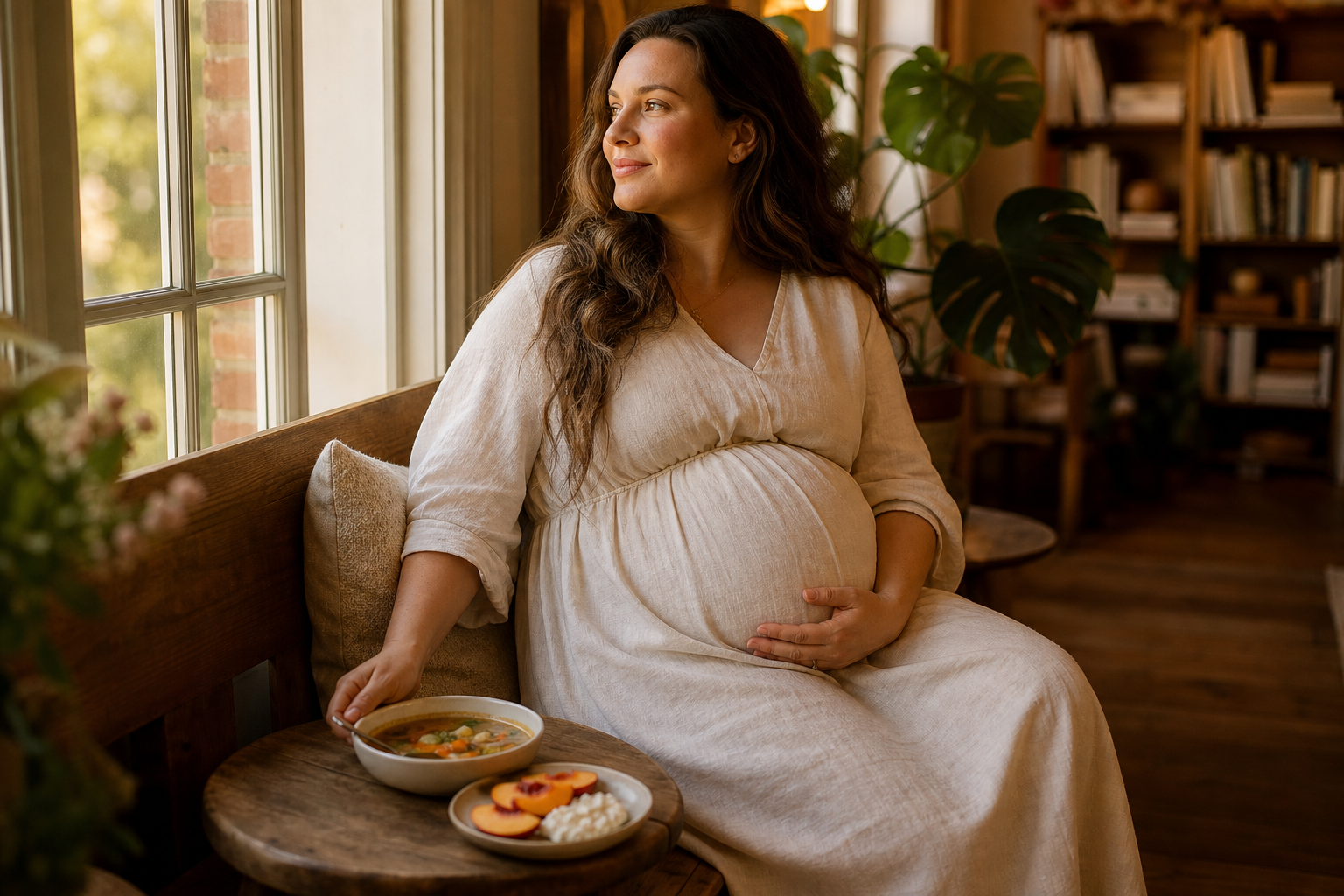
How much weight to gain in pregnancy? General ranges by pre-pregnancy BMI, why gain is healthy, and a non-judgmental dietitian's perspective.
Few questions during pregnancy carry as much quiet anxiety as how much weight to gain in pregnancy. For some clients it surfaces at the very first appointment; for others it sits in the background, shaped by old diet rules, comments from relatives, or numbers seen online. As a dietitian, I want to offer a different starting point: weight gain in pregnancy is not something to fear or fight. It is a sign that your body is doing exactly what it is supposed to do — building a baby, a placenta, extra blood, and the reserves you will need.
This article shares the general ranges that providers commonly reference, explains why that gain is healthy and necessary, and — most importantly — reframes the whole conversation away from numbers and toward nourishment. Everything here is general education. Your own healthy range is something only your midwife or doctor can individualise for you, and they are the right people to track and interpret it.
How Much Weight to Gain in Pregnancy: The General Ranges
Most healthcare systems reference guidance originally developed by the Institute of Medicine (IOM), which gives general weight-gain ranges based on a person's pre-pregnancy body mass index (BMI). I share these gently, because they are population-level guides, not personal targets — and your provider may adjust them for your situation.
As a broad reference for a single (not twin) pregnancy, the commonly cited ranges are:
- Underweight (BMI under 18.5): roughly 12.5–18 kg
- Healthy weight (BMI 18.5–24.9): roughly 11.5–16 kg
- Overweight (BMI 25–29.9): roughly 7–11.5 kg
- Obese (BMI 30 or above): roughly 5–9 kg
I want to be clear about how to hold these numbers. They are starting points for a conversation with your provider, not a test you pass or fail. Plenty of healthy pregnancies sit slightly outside these ranges. Your provider looks at the whole picture — your health, your baby's growth, your history — not a single figure. If your gain looks different from a chart, it is a reason to talk with them, never a reason for shame.
Why Weight Gain in Pregnancy Is Healthy and Necessary
It helps to see where the weight actually goes, because it dissolves a lot of the worry. The gain on the scale is not simply "fat" — it is the infrastructure of a healthy pregnancy.
A rough picture of where pregnancy weight is distributed:
- The baby itself accounts for a meaningful share, especially in later pregnancy.
- The placenta, which delivers oxygen and nutrients to your baby.
- Amniotic fluid, which cushions and protects.
- Increased blood volume, which can rise substantially to supply you and your baby.
- Extra fluid in your tissues.
- A larger uterus and growing breast tissue.
- Maternal fat stores, which your body lays down deliberately to support the demands of late pregnancy, birth, and breastfeeding.
Seen this way, weight gain is not a loss of control. It is your body building everything a baby needs and stocking the reserves you will draw on. Trying to limit it too aggressively can work against your health and your baby's growth — which is exactly why this is a conversation for your provider, not a goal to chase alone.
How Weight Gain Is Distributed Across the Trimesters
Weight gain in pregnancy is rarely steady, and it is not meant to be. Understanding the usual rhythm can ease the anxiety that comes from comparing yourself week to week.
- First trimester: Gain is typically small — often just a kilo or two — and some people gain nothing at all, especially if nausea is suppressing appetite. This is normal.
- Second trimester: As nausea eases and the baby grows, gain usually becomes steadier. This is where much of the change tends to happen.
- Third trimester: Gain often continues steadily, though it may slow slightly in the final weeks. The baby is putting on much of its weight during this period.
Some weeks you will gain more, some less, and the occasional plateau is common. A single weigh-in tells you very little; the overall trend, interpreted by your provider, is what matters. If you ever notice a sudden, sharp gain accompanied by swelling or other symptoms, contact your provider promptly, as that is something they will want to assess.
A Note on Twin and Multiple Pregnancies
If you are expecting twins or more, the ranges above do not apply to you, and the general figures are higher. Guidance for twin pregnancies suggests a greater total gain — for someone of healthy pre-pregnancy weight, often cited in the region of 17–25 kg — but multiple pregnancies are individual and closely monitored. Your provider will give you guidance tailored to your specific pregnancy, and a dietitian can help you meet those higher nutritional needs comfortably. Please treat any number here as general context only and defer to your own care team.
Focusing on Nourishment Over Numbers
Here is the shift I encourage with every pregnant client: spend less energy on the scale and more on nourishing yourself well. When the food is right — varied, balanced, enough — healthy weight gain tends to follow naturally for most people, without daily weigh-ins or anxiety.
What "nourishing yourself well" looks like in practice:
- Eating regularly and enough, rather than restricting. Pregnancy is not the time for cutting back or dieting.
- Building balanced plates — vegetables and fruit, quality protein, whole grains, healthy fats — most of the time, while leaving room for foods you enjoy.
- Responding to your appetite, which genuinely changes through pregnancy and is worth trusting.
- Staying hydrated and active in ways your provider approves, both of which support how you feel.
- Letting go of pre-pregnancy diet rules. Many clients carry restrictive habits into pregnancy without realising; gently setting them down is often the most healing thing we do together.
This nourishment-first approach protects your relationship with food, supports your baby, and tends to make the numbers take care of themselves. Weight is one data point your provider tracks — it is not a measure of how well you are doing as a parent-to-be.
Letting Go of Weight Shame in Pregnancy
I work with many clients who arrive carrying shame about their bodies, sometimes from years before pregnancy and sometimes from comments made during it. I want to say this plainly: there is no version of your body or your weight gain that makes you less worthy of a calm, supported pregnancy. Whether you started at a higher or lower weight, whether your gain is faster or slower than a chart suggests, you deserve guidance free of judgment.
A higher pre-pregnancy weight does mean your provider may monitor a few things more closely, and that is care, not criticism. Likewise, a lower starting weight or limited gain is something they will simply keep an eye on. None of it changes the goal: a nourished you and a growing baby. If anyone — online, in your family, or even a passing comment from a stranger — makes you feel ashamed about pregnancy weight, you are allowed to set that aside and focus on the people actually looking after you.
When to Discuss Weight With Your Provider
Your midwife or doctor is the right person to track and interpret your weight in pregnancy. It is worth raising with them when:
- Your gain seems much faster or slower than expected, and you would like reassurance or a plan.
- Nausea, appetite changes, or food aversions are making it hard to eat enough.
- You started pregnancy at a higher or lower weight and want to understand what that means for you.
- You are expecting twins or more.
- You feel anxious or distressed about weight, food, or your changing body — this matters and deserves support.
A dietitian fits in alongside this care, never instead of it. Where your provider sets the medical picture, I help translate it into food and habits that feel doable and kind.
Working With Hanzi Nutrition
I support clients through pregnancy with a calm, non-judgmental, evidence-informed approach that puts nourishment ahead of numbers. Sessions are online or hybrid, in English or Turkish, and shaped entirely around your life and your goals. Together we build flexible, balanced eating that supports a healthy pregnancy, untangle any weight-related anxiety, and make sure you feel confident rather than fearful about your changing body — all in coordination with your midwife or OB.
If the question of how much weight to gain in pregnancy has been weighing on you, you do not have to carry it alone or piece together conflicting advice from the internet.
Worried about pregnancy weight gain? Contact Hanzi Nutrition for calm, individualised nutrition support that works alongside your provider and puts nourishment first.
Hanzi Nutrition offers online nutrition counselling across the Netherlands, Belgium, Germany, and Turkey, in English and Turkish. This article is general education and not a substitute for personalised medical or prenatal care. Weight-gain ranges are general guidance only; your individual healthy range should be determined and monitored by your midwife, doctor, or healthcare provider.
Continue reading
- A Trimester-by-Trimester Pregnancy Nutrition Plan
- What to Eat with PCOS: A Dietitian's Practical Food Guide
Ready for personalised nutrition guidance? Book a consultation with Hanzi Nutrition, or explore all our services.