A dietitian's baby led weaning guide — readiness, safe finger food sizes, gagging vs choking, iron and allergens, mess tips, and a sample first week.
If the idea of handing your six-month-old a strip of soft toast or a broccoli floret makes you both excited and slightly anxious, you're in good company. Baby-led weaning is hugely popular for good reason — but it raises real, sensible questions about safety. This baby-led weaning guide is designed to answer them honestly: what the approach is, how to do it safely, how to tell gagging from choking, and how to make sure your baby still gets enough iron.
I'll keep this safety-forward throughout, because that's the part parents most need clarity on. And as with everything around infant feeding, treat this as general education — coordinate with your pediatrician or consultatiebureau, especially if your baby was born early or has any feeding or medical concerns.
What Baby-Led Weaning Actually Is
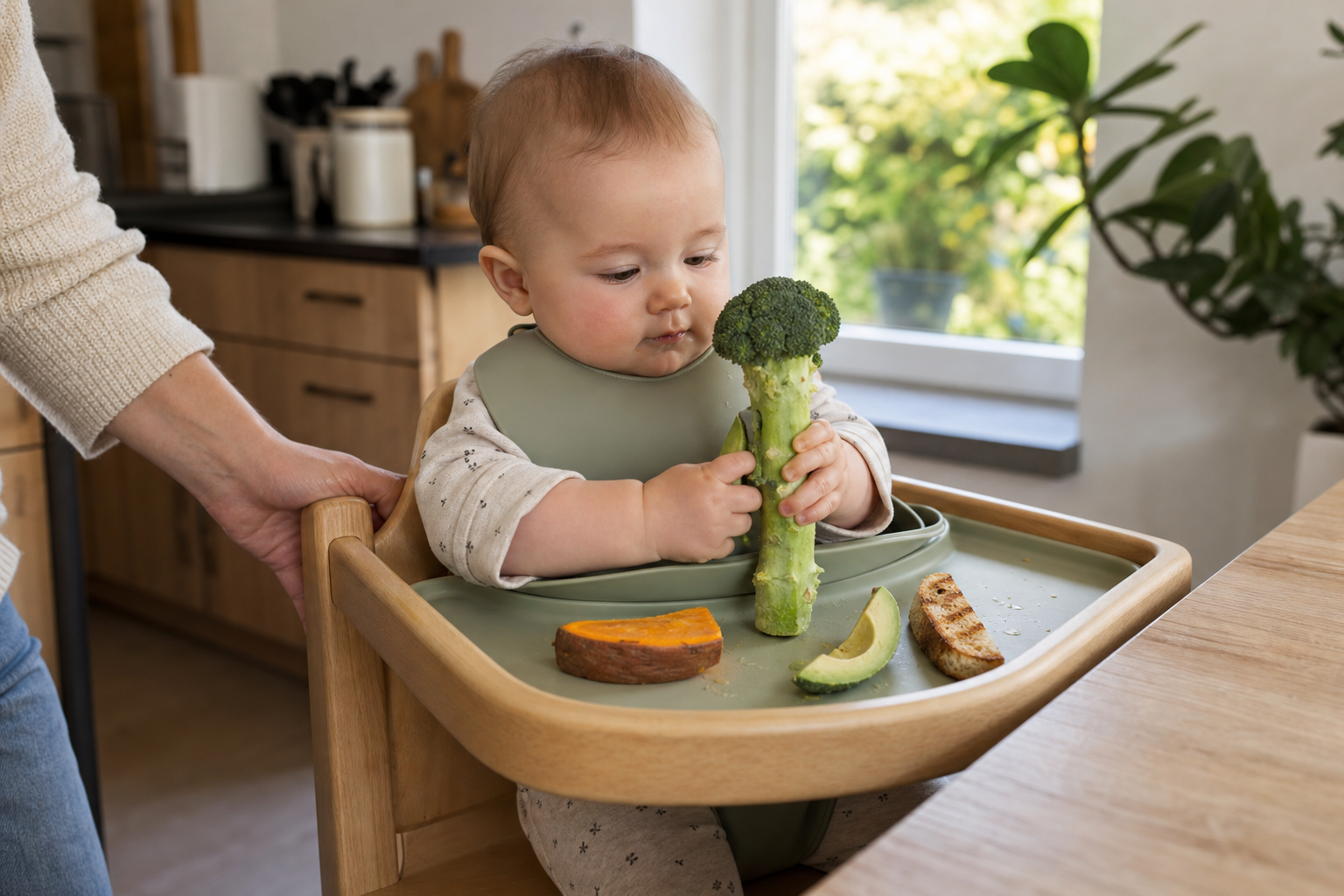
Baby-led weaning (BLW) means skipping the spoon-fed purée stage and instead offering your baby soft, graspable pieces of food that they pick up and feed to themselves from the start, at around six months. The baby controls what goes in their mouth, how much, and how fast.
The appeal is real. BLW lets babies explore textures, practice their pincer grasp, share in family meals from early on, and learn to self-regulate how much they eat. Many parents also find it simpler — less separate cooking, more of "what's on the table, made safe."
It's worth being honest about the limits, too. BLW is not magic: it doesn't guarantee a baby will never be fussy, and it isn't automatically "better" than spoon-feeding. Both approaches, done well, raise happy eaters. What matters most is that food is offered safely, that iron is covered, and that mealtimes stay relaxed.
Baby-Led Weaning vs Purées — and Why You Can Combine Them
You don't have to choose a side. In my practice, a blended approach is the most common and often the most practical.
- Pure BLW: finger foods only, from the start.
- Spoon-led: purées progressing to lumps and then finger foods.
- Combination: offer soft finger foods and loaded spoons or purées — for example, finger foods at one meal and a spoonful of iron-fortified cereal or yoghurt at another.
A combination approach has real advantages. It lets your baby self-feed and explore while ensuring iron-rich, energy-dense foods (which can be harder to deliver via finger foods alone in the early weeks) still get in. There's no prize for purism here. Follow your baby and your family's rhythm.
Is Your Baby Ready? The Readiness Signs
BLW relies even more than spoon-feeding on genuine readiness, because your baby will be handling food independently. Look for these three signs together, at around six months:
- Sitting steadily and holding their head up well — essential for safe self-feeding.
- Loss of the tongue-thrust reflex, so food can move back in the mouth rather than straight out.
- Reaching for food and bringing it to the mouth — the hand-to-mouth coordination BLW depends on.
If your baby can't yet sit upright and bring a piece of food to their own mouth, they're not quite ready for finger foods — give it another week or two. Always seat your baby fully upright in a high chair, never reclined, and never let anyone else (including older siblings) put food into your baby's mouth.
Safe First Finger Foods: Sizes and Shapes That Matter
This is the heart of a safe baby-led weaning guide, so I'll be specific. In the early weeks, foods should be soft enough to squash between your finger and thumb, and cut into shapes a baby can grip but not choke on.
- Size and shape: offer pieces roughly the length and width of an adult finger. A long strip gives your baby something to hold with a fist while gnawing the end. As the pincer grasp develops (around 8–9 months), you can move to smaller pieces.
- Softness test: if you can't easily squash it between two fingers, it's too hard. Steam, roast, or cook firm vegetables and fruit until soft.
Good early finger foods include:
- Steamed or roasted vegetable strips — sweet potato, carrot, courgette, broccoli and cauliflower florets (the floret gives a built-in handle).
- Soft fruit — ripe banana (leave a section of peel for grip), soft pear or peach wedges, ripe avocado strips.
- Toast fingers or soft cooked pasta, and well-cooked egg cut into strips.
- Soft-cooked meat or fish, flaked or in strips you've checked for bones.
Make hazardous foods safe by modifying them: quarter grapes and cherry tomatoes lengthways, never whole; grate or cook hard apple and carrot until soft; spread nut butters thinly (never a thick blob or whole nuts); remove all bones, pips, stones, and stringy skins. Avoid whole nuts, popcorn, hard raw chunks, and anything round, firm, and the size of your baby's airway.
Gagging vs Choking: What the Difference Really Is
This is the worry that keeps parents up at night, so let's be factual and reassuring. Gagging and choking are not the same thing.
- Gagging is normal, common, and protective. It's a reflex that pushes food forward when it's gone back too far before your baby is ready to swallow it. A gagging baby is usually noisy — coughing, spluttering, perhaps going red, eyes watering — and moving air. This is your baby's body doing its job and learning. The gag reflex actually sits further forward in the mouth in young babies, which is protective. The best thing you can do is stay calm and let them work it out; reacting with alarm can frighten them.
- Choking is quiet and serious. A truly choking baby usually can't make much noise, may go silent, may turn blue around the lips, and is not effectively moving air. This needs immediate action.
Because of this, two things are non-negotiable, regardless of whether you do BLW or purées: always supervise every meal with your baby seated upright, and take an infant first-aid/choking course before you start. Knowing what to do in the rare event of true choking is the single most reassuring step you can take, and it applies to all feeding styles, not just BLW. Research suggests BLW does not carry a higher choking risk than spoon-feeding when safe-food rules are followed — but those rules are what make it safe.
Covering Iron and Allergens Within BLW
Two nutrition priorities sit inside any good BLW plan.
Iron. Around six months, your baby's iron stores start to run low, and milk is low in iron. With finger foods this takes a little planning, because some classic iron sources are tricky to hand over. Build in soft strips of well-cooked meat, flaked fish, mashed or smashed lentil and bean patties, and offer iron-fortified cereal on a pre-loaded spoon (this is where the combination approach shines). Pair plant iron with a little vitamin C — soft fruit, cooked tomato or pepper — to boost absorption.
Allergens. Current guidance is to introduce common allergens early and often, from around six months. Within BLW that might look like well-cooked egg strips, smooth peanut butter thinly spread on a toast finger, or a little yoghurt on a spoon. Introduce one new allergen at a time, earlier in the day, and keep offering tolerated foods regularly. If your baby has severe eczema, an existing allergy, or a strong family history, speak to your pediatrician before introducing allergens so you can follow a tailored plan.
Practical Mess and Logistics Tips
BLW is gloriously messy in the early weeks. A little setup makes it manageable.
- Protect the zone: a wipe-clean mat or old shower curtain under the high chair saves your floor and lets you scoop and reuse drops.
- Dress for the job: a long-sleeved, full-coverage bib (or just a nappy in warm weather) beats fighting stained clothes.
- Embrace the learning: food in the hair and on the floor is normal exploration, not waste in the way it feels. Offer two or three pieces at a time rather than a full plate to reduce overwhelm and floor casualties.
- Eat together when you can: babies learn by copying. Sharing a meal — even a snack — models chewing and turns mealtimes social.
- Don't pressure: never coax or hurry. Let your baby decide how much to eat; milk still covers the bulk of their nutrition in these early months.
A Sample First Week of Baby-Led Weaning
A gentle way in, offered once a day after a milk feed when your baby is calm. Stay seated with them the whole time.
- Day 1: a soft strip of steamed sweet potato.
- Day 2: a steamed broccoli floret (the stalk makes a perfect handle).
- Day 3: a wedge of ripe avocado or soft pear.
- Day 4: a strip of well-cooked egg (your first allergen) — offer earlier in the day.
- Day 5: soft-cooked pasta or a toast finger.
- Day 6: a strip of soft-cooked meat or a smashed lentil patty for iron.
- Day 7: a toast finger with a thin scrape of smooth peanut butter (second allergen).
From here, build toward two then three small meals a day, widening textures and flavours, and folding your baby into family meals — minus added salt, sugar, honey (before 12 months), and choking hazards.
Working With Hanzi Nutrition
Baby-led weaning is rewarding, but the safety details and iron planning are exactly where parents most value a steady, expert hand. As a dietitian, I help families start BLW (or a sensible combination) with confidence — building safe finger-food plans, covering iron and allergens, and easing the worry around gagging — all working alongside your pediatrician or consultatiebureau rather than replacing them.
I support families across the Netherlands, Belgium, Germany, and Turkey, fully online and in English or Turkish, so you can get tailored guidance wherever you live.
Thinking about baby-led weaning? Contact Hanzi Nutrition to build a safe, iron-smart BLW plan for your baby.
Hanzi Nutrition offers online nutrition counselling across the Netherlands, Belgium, Germany, and Turkey, in English and Turkish. This article is general education and not a substitute for individual medical advice. Always supervise your baby while eating, learn infant choking first aid before starting solids, and coordinate feeding with your pediatrician or consultatiebureau, as every baby develops differently.
Continue reading
- Baby's First Foods: A Starting Solids Schedule You Can Actually Follow
- What to Eat with PCOS: A Dietitian's Practical Food Guide
Ready for personalised nutrition guidance? Book a consultation with Hanzi Nutrition, or explore all our services.