Looking for an English speaking dietitian Netherlands-wide? Here is how online nutrition care works for expats, what to look for, and how Hanzi can help you.
If you have ever sat in a Dutch waiting room rehearsing how to explain your symptoms in a language you only half-speak, you already understand the problem. Finding an English speaking dietitian in the Netherlands can feel like one more piece of admin in a country that already asks a lot of newcomers: a BSN number, a health insurance plan you do not fully understand, a GP who books out three weeks ahead. Add nutrition to that list and many expats simply give up and try to fix things on their own with whatever they read online.
I work with expats every week, and I want to make this part easier. As a Turkish dietitian who has spent years supporting international clients across the Netherlands and the rest of Europe, I know that the language barrier is rarely the real issue. The real issue is finding someone who understands your food, your situation, and your goals — and who can communicate with you clearly. Let me walk you through how to find that person, how online care actually works, and what to look for before you book.
Why Expats Struggle to Find Nutrition Care in the Netherlands
The Dutch healthcare system is genuinely good. It is accessible, evidence-based, and far cheaper at the point of use than systems in many other countries. But it was built for Dutch speakers, and that shows up in small frustrations that add up.
- Language at the clinical level is harder than language at the café. You might order coffee in Dutch comfortably and still struggle to discuss blood sugar, gut symptoms, or a complicated relationship with food. Nutrition is personal and detailed, and nuance matters. Working in a shared, fluent language removes a layer of stress and reduces the chance of being misunderstood.
- The GP gatekeeper model feels unfamiliar. Many expats come from systems where you book a specialist directly. In the Netherlands, the huisarts (GP) sits at the center of care. The good news, which surprises people, is that you do not actually need a GP referral to see a dietitian here. More on that below.
- Food culture does not match. Standard Dutch dietary advice assumes a Dutch plate. If your kitchen runs on Turkish, Indian, Italian, Brazilian, or Middle Eastern food, generic advice to "eat more brown bread and a glass of milk" lands flat and gets ignored.
- Time and location. New arrivals often move cities for work, commute long distances, or simply have packed weeks. Travelling across town to a clinic during working hours is a real barrier.
None of these problems mean you should skip nutrition support. They just mean the traditional in-person, Dutch-language route is not always the right fit — and that is exactly where online care has changed things.
How Online Dietitian Care Works for Expats
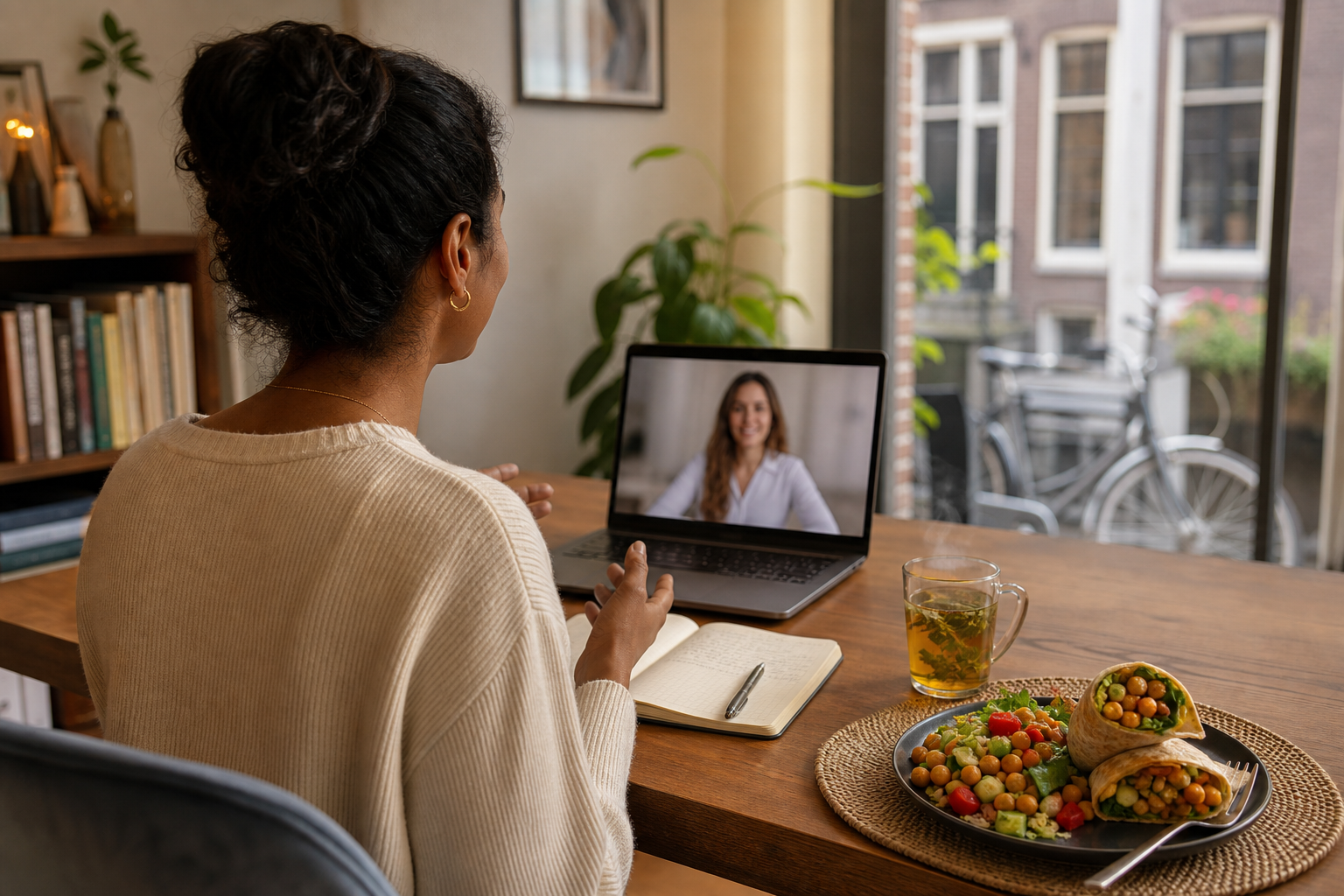
When I tell people I work online, a few of them imagine something thin: a generic meal plan emailed over, maybe a quick chat. That is not what good online dietitian care looks like, and it is worth explaining how it actually runs.
A proper online process usually starts with a longer intake consultation, often around an hour. We talk through your medical history, current eating patterns, symptoms, lifestyle, work schedule, sleep, stress, and what you actually want to change. I ask about the foods you grew up with and the foods you reach for now, because a plan you will not eat is a plan that fails.
From there, you receive a personalized plan built around your real life, not a template. Follow-up sessions, usually shorter, track what is working, adjust what is not, and keep you accountable in a supportive way. Between sessions, most online dietitians stay reachable by message for the small questions that come up at the supermarket or a restaurant.
The practical advantages for expats are significant:
- No commute, no waiting room. You join from your living room, your office, or even from abroad when you travel home.
- Continuity if you move. Expats relocate. If you move from Amsterdam to Eindhoven, or even back to your home country for a few months, your care does not have to restart.
- Flexible scheduling. Early mornings and evenings are easier to arrange online than in a busy physical clinic.
- Records and resources in writing. Plans, food lists, and notes arrive in a format you can re-read in your own time — which matters when the conversation is in your second or third language.
Online care is not right for absolutely everything. Some situations need hands-on medical assessment, and I will always say so. But for the large majority of nutrition goals, video consultations are just as effective as sitting in the same room — and far more convenient.
What to Look For in an English Speaking Dietitian in the Netherlands
Not everyone offering nutrition advice online is qualified, and the titles can be confusing. Here is how to choose well when you search for an English speaking dietitian in the Netherlands.
- Check the qualification, not just the label. "Dietitian" is a protected, regulated title in most of Europe and requires a recognized degree and clinical training. "Nutritionist" or "nutrition coach" can mean many things, from highly qualified to barely trained. Ask directly about education and registration.
- Look for registration and accountability. In the Netherlands, registered dietitians are listed in professional registers and work to a clear code of conduct. A qualified dietitian should be comfortable telling you where they are registered and what their credentials are.
- Evidence-based, not trend-based. A good dietitian leans on science, is honest about what nutrition can and cannot do, and will never promise a cure or a guaranteed result. Be cautious of anyone selling miracle protocols, detoxes, or one-size-fits-all programs.
- Genuine language and cultural fit. Fluent English is the baseline. Cultural fit is the multiplier. Someone who understands your cuisine can adapt your favourite meals rather than replace them, which is the difference between a plan that lasts and one you abandon by week three.
- Clear scope and honesty about limits. A trustworthy dietitian works alongside your doctor for any medical condition and refers on when something falls outside nutrition. That honesty is a sign of good practice, not a weakness.
If you take one thing from this section, make it the first point: confirm the qualification before you confirm the calendar slot.
Insurance Basics: The Basisverzekering and Dietitian Care
Cost is one of the first questions expats ask, so here is a brief, general overview. This is education, not insurance advice — always check your own policy for the specifics.
If you are a resident, you are legally required to hold basic health insurance, the basisverzekering. Under the basic package, adults are generally entitled to a few hours of dietary advice (dieetadvisering) from a registered dietitian each calendar year. A useful and often-missed detail: in the Netherlands you can usually go to a dietitian without a GP referral, thanks to direct accessibility rules.
Two things commonly trip people up:
- The deductible (eigen risico). There is an annual deductible you pay before basic insurance starts covering most care, so your first sessions of the year may come out of your own pocket regardless.
- Contracted versus non-contracted providers. Whether a dietitian has a contract with your specific insurer affects how much is reimbursed. Children are generally covered more fully, with the deductible not applying.
For some expats, the cleanest path is simply paying a transparent private rate for online sessions and skipping the insurance maze entirely — especially in the early part of the year before the deductible is met. For others, using their covered hours makes more sense. There is no single right answer; it depends on your policy and your needs. Always confirm details with your insurer.
Conditions and Goals Commonly Supported
People come to nutrition care for very different reasons. Across the expats I work with, these are the most common, and all of them can be supported well online:
- Gut health and digestion. Bloating, IBS-type symptoms, and food intolerances respond well to structured, personalized dietary work, including approaches like low-FODMAP when appropriate.
- Weight and body composition goals. Sustainable, non-extreme approaches that fit a busy expat life, free of diet-culture shame.
- Blood sugar and metabolic health. Supporting goals around type 2 diabetes, prediabetes, and insulin resistance, always alongside medical care.
- Women's health. Nutrition support for PCOS, hormonal balance, fertility goals, pregnancy, and postpartum recovery, working in coordination with your doctor or midwife.
- Heart health. Supporting goals around cholesterol and blood pressure with Mediterranean and DASH-leaning eating patterns.
- Everyday energy and habits. Building a calm, sustainable relationship with food, more steady energy, and meals that actually fit your week.
A consistent theme: nutrition supports your health goals and works alongside any medical treatment you are receiving. It does not replace your doctor, and a good dietitian will always be clear about that line.
Working With Hanzi Nutrition
I run a dietitian-led online practice and work with expats and international clients right across the Netherlands — Amsterdam, Rotterdam, The Hague, Utrecht, Eindhoven, Tilburg, and everywhere in between. Because everything runs online, your postcode does not limit your access. Whether you have just landed in Amsterdam or you have been settled in Tilburg for years, the care is the same.
Sessions are in English or Turkish, built around your cuisine and your real schedule, and grounded in evidence rather than trends. I am honest about what nutrition can and cannot do, I work alongside your doctor for any medical condition, and I keep plans practical enough to actually follow. You get a real relationship with one qualified dietitian, not a rotating cast of coaches or an app that forgets who you are.
Looking for an English-speaking dietitian who gets your food and your life in the Netherlands? Contact Hanzi Nutrition to book an intake and start with a plan built around you.
Hanzi Nutrition offers online nutrition counseling across the Netherlands, Belgium, Germany, and Turkey, in English and Turkish. This article is general education and is not a substitute for personalized medical or dietary care; please coordinate any medical condition with your doctor.
Continue reading
- Online Dietitian in Antalya: How Online Nutrition Counseling Works
- What to Eat with PCOS: A Dietitian's Practical Food Guide
Ready for personalised nutrition guidance? Book a consultation with Hanzi Nutrition, or explore all our services.